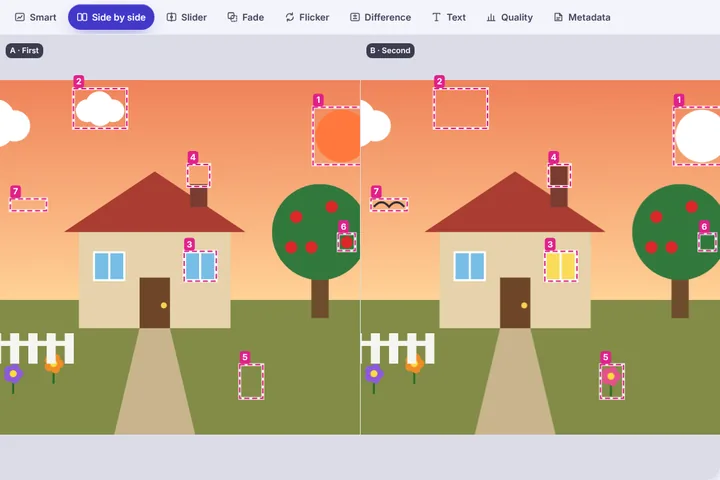
Show A, then B, in the same place, over and over: anything that changed seems to jump, because your eye is far better at noticing movement than at reading two pictures side by side.
Why blinking finds what staring misses
Astronomers found new planets and asteroids with a blink comparator: two photographic plates of the same patch of sky, shown alternately through one eyepiece. Stars stay put; anything that moved between the nights hops back and forth. Pluto was discovered this way in 1930.
The same trick defeats change blindness — the well-studied tendency to miss even large edits when two scenes are shown one after another with a gap, or side by side. Removing the gap and keeping both pictures in exactly the same place turns a change into motion, and motion is what the eye catches first.
Hold first, automatic second
Holding the button (or Space) shows B for as long as you hold it and A when you let go, so you set the pace and can study one area at a time. Automatic switching is there for a hands-free look, and starts slow.
Before the two pictures are blinked they are lined up: a resized or slightly shifted copy is scaled and moved onto A first, so the whole frame does not jump and only the parts that really differ move.
Motion safety
Repeated flashing can be uncomfortable and, for some people with photosensitive epilepsy, dangerous. Automatic switching is off until you turn it on, never goes faster than three switches a second, asks before using its fastest speed, and stays off if your device is set to reduce motion unless you confirm. Holding the button is always available instead.